
How You Wear Your Body Camera Matters More Than You Think
Updated: Jul 25
Most departments spend months comparing body cameras. Resolution. Battery life. Cloud storage. Upload speeds. All of it matters. None of it matters if the camera ends up pointed at the ceiling when it counts.
Where a body camera sits on an officer, and how securely it stays there, determines whether the footage is usable. A camera that shifts during a struggle, pops off during a foot pursuit, or slides out of position on a long shift isn't just inconvenient. It's a gap in the record. And gaps in the record cost departments in court.
The mounting conversation doesn't get enough attention. That's a problem worth fixing.
The Camera Is Only as Good as Its Position
Think about what an officer's body goes through in a single shift. There's constant physical movement: getting in and out of a vehicle, walking, running, bending, and responding quickly under pressure. There are confrontational situations where force is used and equipment takes real stress. There's rain, heat, body armor, and a dozen different uniform configurations depending on the department and the assignment.
A camera mounted for a desk job is not mounted for police work.
The footage from a body camera is only useful if it captures what it was supposed to capture from an angle that's actually usable as evidence. That means departments need body-worn cameras that stay where they were placed, hold position under physical stress, and work the same way whether an officer is wearing a patrol shirt on a Tuesday morning or full tactical gear on a Friday night callout.
That's not a camera problem. That's a mounting problem.
One Uniform Doesn't Fit All
Here's where departments get into trouble. A lot of vendors ship a single mounting solution with every camera. One clip, one attachment point, one method for every officer regardless of how they're dressed or what they're doing.
That doesn't work.
A patrol officer in a standard uniform shirt has different needs than a K9 handler in a tactical vest. A detective in plainclothes needs a different setup than a motorcycle officer. An officer who rotates between a soft shell uniform and a level III carrier can't be expected to use the same clip for both.
LensLock partners with Peter Jones, the manufacturer behind the Klick Fast mounting system, to give departments real options. The Klick Fast system is used by first responders worldwide precisely because it was built for this kind of variety. It's not one-size-fits-all. It's the right fit for the actual setup.
The Klick Fast System: How It Works
Before getting into the specific options, it helps to understand how the system is built.
Every Klick Fast mount is built around two components: a Connector and a Dock.
The Connector attaches to the camera or holder. The Dock attaches to the uniform, vest, or gear. The Connector slides into the Dock and locks in place. Once docked, the camera can rotate into any of seven ratcheted positions and lock there, so officers can angle the camera exactly where they need it and it stays put.
The system is tested and rated for 50,000 rotations. That's not a marketing number. That's a durability guarantee built for equipment that gets used hard every day.
There are three Connector options depending on the situation:
Standard Connector. The everyday workhorse. Slides in, locks securely, releases when needed.
Ultra-Lock Connector. Adds a double-lock mechanism. Extra release action required to remove the device. Built for high-risk situations where accidental removal during a physical confrontation is a real concern.
Go Connector. Designed for situations where speed of release matters more than maximum retention. Grab and go, no inversion required. Useful for officers who need to quickly move a camera or transfer footage in the field.
The right Connector depends on the assignment. Departments can configure across their fleet based on what their officers actually do.
Mounting Options: Matching the Mount to the Setup
Klick Fast Magnetic Mount
The magnetic mount is built for departments that need flexibility across different garments without permanently altering any of them.
A back plate sits behind the garment or inside a pocket. A front plate holds the Dock on the outside. Eight high-strength magnets hold the assembly firmly in place through the fabric.
This is the right choice when officers rotate between different uniforms and outerwear, when sewing or drilling into department-issued gear isn't an option, and when a department needs a solution that works across a mixed fleet of uniform types without managing multiple different setups.
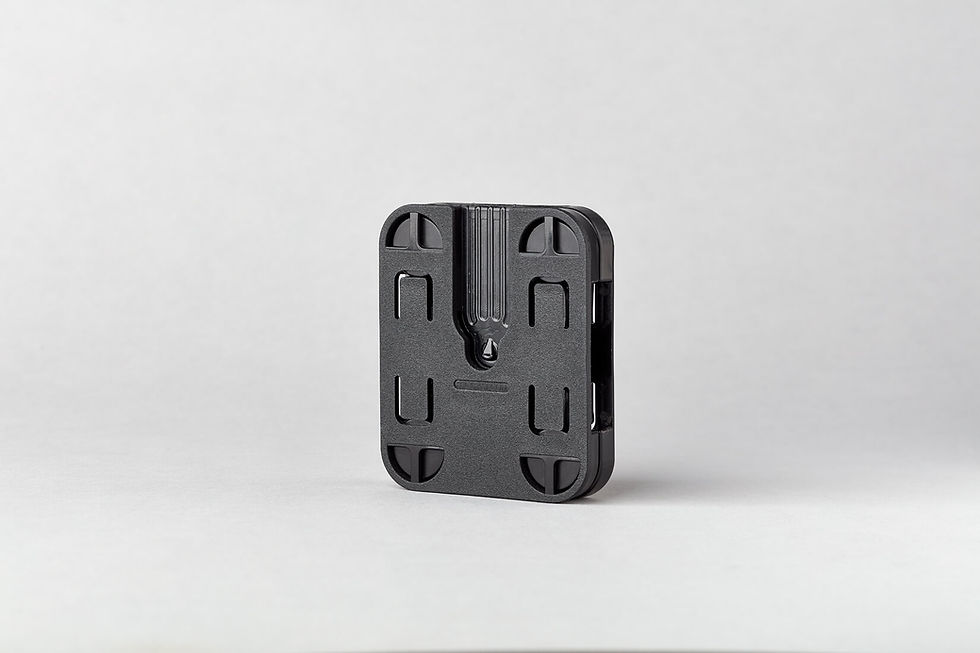
Klick Fast Quad MOLLE Dock
For officers wearing tactical vests, plate carriers, or any load-bearing equipment with PALS webbing, this is the stable option.
The Quad MOLLE Dock fastens across two rows of MOLLE loops through four vertical slots. It's a one-piece design that keeps weight down while creating a secure, repositionable attachment point that doesn't rely on fabric tension or garment construction to stay in place.
Tactical assignments, special operations, K9 units. Anyone running MOLLE-based gear. The camera goes where the officer goes and stays there.

Klick Fast Crocodile Garment Clip
The most versatile option for standard patrol uniforms.
The spring-loaded clip opens so the back plate can slide behind a shirt placket, epaulette, pocket, belt, or jacket zip opening. It then closes over the outer layer with serrated teeth and spring tension that maintain a firm grip on fabric.
It attaches vertically or horizontally on a shirt placket. The camera can be docked in any orientation and rotated to the angle the officer wants. A slim profile keeps the mount discreet beneath the device. An optional Anti-Tilt Attachment is available for looser or ill-fitting garments.
This is the everyday patrol mount for officers on a standard uniform shirt.

Klick Fast Epaulette Dock
For shirts, jackets, and outerwear with epaulettes, this mount positions the camera at the shoulder. It's a secure placement for daily patrol that still allows quick removal when needed.

Screw-On and Screw-to-Fit Docks
For departments that want fixed, consistent placement that doesn't shift between wearings, the screw-based options provide maximum stability. The camera goes on the same spot every time.
These are a good fit for agencies that have standardized their uniform setup and want a mount that reflects that consistency.

Clip-On Dock
A lightweight, practical option for quick attachment to clothing and lighter gear. When the assignment doesn't require a tactical setup and simplicity is the priority, this gets the job done.

Why This Matters for Evidence
There's a practical legal argument for getting the mounting right.
Defense attorneys look for gaps in body camera footage. A camera that shifted out of position, activated but pointed the wrong direction, or came off during a use-of-force incident creates an evidentiary gap that's difficult to explain in court. Prosecutors and internal affairs investigators rely on clean, consistent footage, and strong digital evidence management starts with footage that clearly captures what happened. Mounting consistency is part of what produces that.
Beyond court, there's the officer protection angle. Body cameras exist in part to protect officers from false complaints. A camera that was positioned correctly and stayed in position through an incident produces footage that tells the full story. A camera that fell or shifted tells a partial one.
The best camera in the world doesn't help if the footage shows the ground.
Helping Departments Choose the Right Setup
There's no single right answer for every department. The right mount depends on what officers wear, what assignments they run, and how their uniforms are configured.
That's exactly the kind of conversation LensLock has with every department before deployment. The goal isn't to sell a mount. It's to make sure the camera is positioned where it needs to be, stays there under real conditions, and produces footage that holds up.
Departments comparing mounting options may also want to review real body camera reviews from agencies using LensLock in the field.
If your department is evaluating body cameras or reviewing your current mounting setup, that conversation is worth having before the cameras go out the door.
Talk to LensLock about mounting options for your department. Call 866-536-7562 or explore body camera accessories built for patrol uniforms, tactical gear, and daily field use.



Comments