
School Resource Officer Body Camera Policy: Student Privacy, Records Requests and Who Controls the Footage

Recording inside a school does not automatically make body camera footage an education record under FERPA. The answer depends on who created the recording, why it was created and who maintains it.
That is why a school resource officer body camera policy must settle more than when to press record. When police officers wear body cameras in schools, the policy must say who keeps the original, who gets copies, who answers requests and who can delete what. Those decisions affect accountability, security and oversight of school-based law enforcement efforts. State public-records law, the SRO agreement and agency policy all sit on top of the federal question.
This is general information, not legal advice. Have district and agency counsel review the final policy.
WHAT A BODY CAMERA CAN DOCUMENT IN A SCHOOL, AND WHAT IT CANNOT
School police body cameras can capture contemporaneous audio and video of what happened in front of an officer. That footage can help with an incident review, a complaint investigation or a criminal case.
By itself, it shows one field of view from one position and can miss what happened before activation, behind the officer or outside the frame. It is not automatically complete, neutral or objective. The National Institute of Justice describes the broader evidence on body camera effectiveness as mixed, so a school program should not promise outcomes the research has not established.
BODY CAMERA FOOTAGE AND FERPA: WHEN IS IT AN EDUCATION RECORD?
THE LAW ENFORCEMENT UNIT RECORD TEST
Under 34 CFR 99.8, a record is a law enforcement unit record when it is:
created by a law enforcement unit;
created for a law enforcement purpose; and
maintained by the law enforcement unit.
When all three conditions are met, the original is excluded from FERPA's definition of an education record. FERPA then neither requires nor prohibits its disclosure. That does not make the footage public. State public-records law, juvenile-record rules, agency policy and court orders still apply.
An education record keeps its protected status when the law enforcement unit receives it.
WHAT HAPPENS WHEN A COPY GOES INTO A DISCIPLINE FILE
The U.S. Department of Education explains that if a law enforcement unit gives a copy of its video to another part of the school and that copy is kept for disciplinary action, the copy may become an education record.
The original and the copy can carry different legal classifications. The written policy should say who may receive a copy and why.
WHO CONTROLS THE FOOTAGE? SEVEN SEPARATE QUESTIONS
"Who owns the footage" is really several questions. Ownership language in a contract or policy does not, by itself, decide whether a particular copy is an education record.
Ownership: which entity the agreement names as owner of the recordings.
Custody: who maintains the original. This matters to the 34 CFR 99.8 classification.
Records custodian: who receives and processes records requests for the original.
Platform access: who can log in, view and tag the file.
Sharing and export authority: who can send a copy to a school administrator, prosecutor or court.
Public-release authority: who decides whether footage is released, redacted or withheld.
Retention and deletion control: who sets retention categories, applies legal holds and approves deletion.
The SRO agreement, agency policy, district policy, vendor agreement and state law should answer these the same way.
THREE COMMON OPERATING ARRANGEMENTS
District police. Some districts run their own police department. Cherokee County School District in Georgia limits access to personnel authorized by its district police department and keeps recordings no more than 90 days unless an ongoing investigation or criminal proceeding requires them.
A local police department assigns SROs. Here, police officers remain under department supervision, and the local police department usually maintains the recordings. Lake Stevens School District in Washington says police body cameras are governed by law enforcement policy and state law, that the district does not access, manage or retain that video, and that requests go to the police agency.
An outside SRO is not automatically a school official under FERPA. The Department of Education's SRO guidance says an SRO can qualify only under set conditions, including direct school control over the use and maintenance of education records, and calls an MOU the best practice for defining those responsibilities.
Split control. Canton Department of Public Safety in Michigan keeps criminal or evidentiary recordings as police evidence. Noncriminal SRO recordings made in school are exported to the district, treated as district property and deleted from the police server. That is one agency's written allocation, not a national rule.
PARENT ACCESS TO SRO BODY CAMERA FOOTAGE
When a video is an education record directly related to a student, a parent or eligible student generally has a right to inspect and review it. FERPA generally does not require the school to hand over a copy.
When the same video is directly related to several students, the school may need to redact or segregate the other students where that can reasonably be done without destroying the record's meaning. If the footage is a law enforcement unit record, FERPA's inspection right does not apply to it, and the request moves to the agency's records process.
A police request runs the other way. If a school-maintained video is an education record, the school generally needs consent or a valid FERPA exception, such as a health or safety emergency, a judicial order or a lawfully issued subpoena, before giving it to police.
HOW A PUBLIC RECORDS REQUEST CHANGES THE ANALYSIS
A law enforcement unit record is outside FERPA, but it is not automatically public. State public-records law and other applicable confidentiality, juvenile-record and court rules determine what can be disclosed.
Ohio is one example. Ohio Revised Code section 149.43 excludes restricted portions of body-worn and dashboard camera recordings from the definition of a public record. A restricted portion includes the image or identity of a child who is a primary subject of the recording when the agency knows or has reason to know the person is a child. That is Ohio's rule. Other states treat the same footage differently.
Unexplained or inconsistent use of exemptions can look like footage is being withheld. State the legal basis and policy reason when footage is delayed, redacted or not released.
KEEP ROUTINE SCHOOL DISCIPLINE SEPARATE FROM LAW ENFORCEMENT ACTIVITY
Routine school disciplinary matters, such as dress-code violations, belong with school administrators unless separate conduct creates a law-enforcement matter.
One NIJ-sponsored study found mixed relationships between SRO implementation and school climate. A separate NIJ-sponsored study recommends that district and law enforcement leaders develop guidelines for SRO involvement in student discipline. The ACLU's 2015 position raises surveillance and discipline concerns from an advocacy standpoint.
The City of Fairfax SRO agreement in Virginia keeps routine discipline with administrators, places SROs under police supervision and points body camera activation to the police department's general order.
WHEN SCHOOL RESOURCE OFFICERS SHOULD RECORD, AND WHERE THEY SHOULD NOT
Are officers required to turn on body cameras? No single federal rule sets activation for SROs. The BJA Toolkit addresses required, discretionary and prohibited recording; its implementation guidance covers viewing, use, release, storage and audits or controls.
For school police, that means naming the enforcement and investigative encounters that require activation, the lawful exceptions and how exceptions are documented. The Baltimore City School Police Force's July 2024 pilot did not allow body cameras on in-school student calls during school hours or school activities. That was one dated pilot, not a national standard.
Sensitive locations need the same precision: restrooms, locker rooms, nurse offices, counseling spaces, classrooms and special-education settings. No single national rule governs recording in these places. The policy should say, for each one, whether recording is required, discretionary or prohibited, and which emergency or enforcement exceptions apply.
This is where oversight versus privacy must be resolved in writing rather than left to an officer during an encounter.
WHAT A SCHOOL RESOURCE OFFICER MOU SHOULD SETTLE
Who employs and supervises the SRO, how school duties differ from police duties, and whether the SRO is designated as the school's law enforcement unit
Required, permitted and prohibited recording during calls, investigations, searches and arrests
Activation and deactivation rules, and how exceptions are documented
Notice requirements
Sensitive locations and conversations
Who maintains the original and who may receive a copy
How parent requests, public-records requests, subpoenas and prosecutor requests are routed
Retention categories, legal holds and deletion approval
Who can access, share, export, redact and delete footage
Audit history and supervisor review
Initial and recurring training for officers, supervisors and records staff
What happens to footage if the SRO agreement or vendor contract ends
WHAT DIGITAL EVIDENCE MANAGEMENT MUST SUPPORT
Evaluate a digital evidence management system for authorized access, audit logs, chain-of-custody history, case organization and data controls, evidence sharing, body camera redaction and evidence export. Footage release, retention and deletion still have to follow the agency's written retention schedule and legal-hold process.
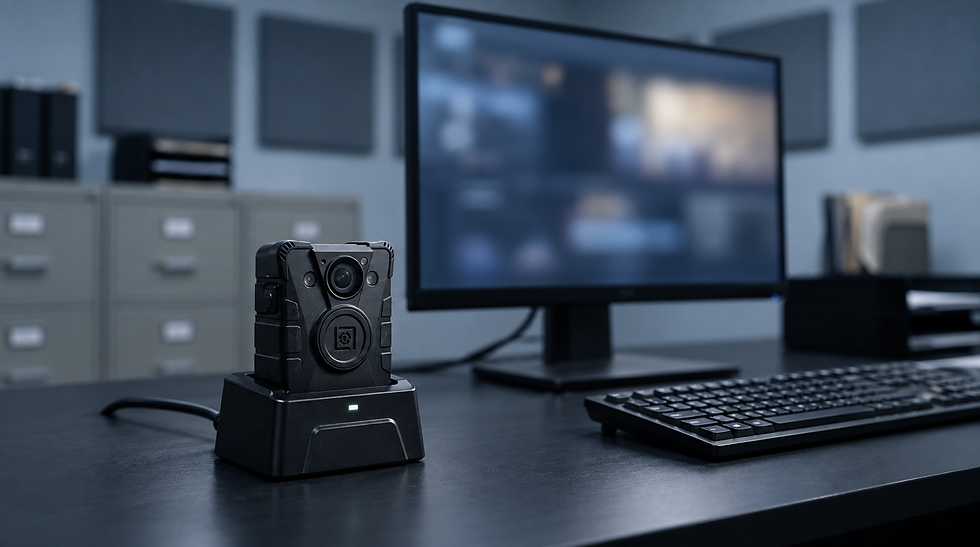
The system does not decide whether FERPA applies or whether footage must be released. During evaluation, confirm which controls the evidence management platform provides and whether authorized personnel can carry out the MOU and agency policy.
WHERE LENSLOCK FITS
Technology should support the policy the district and agency set, not replace it. LensLocker digital evidence management supports agency-specific roles and access permissions, chain-of-custody reporting, case organization and metadata, and sharing with authorized recipients. The Jacksonville Independent School District Police Department in Texas runs LensLock body cameras and uses LensLocker to share evidence with the district attorney's office. If your district and agency are writing or revising an SRO body camera policy, we can walk through how those controls map to it.


Comments